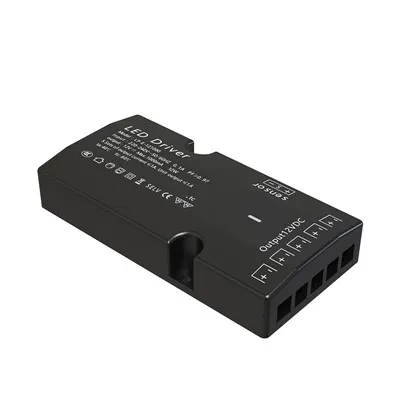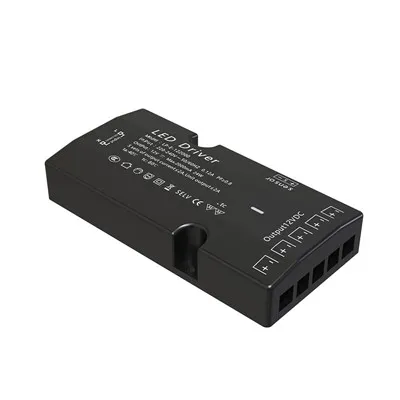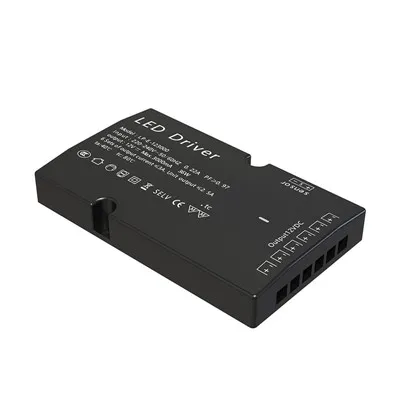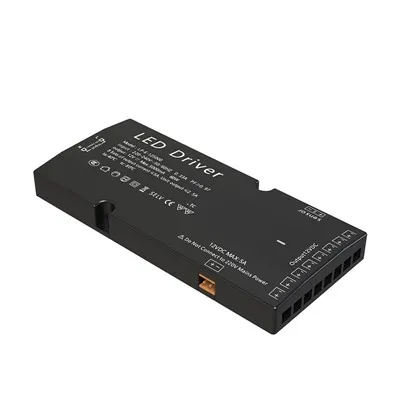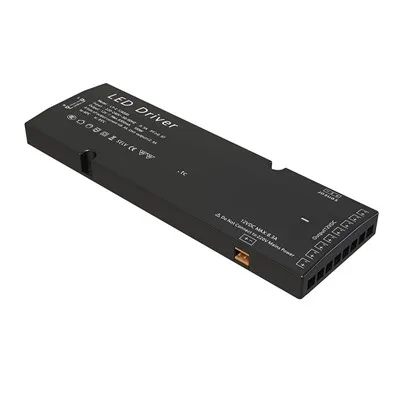

Based on the power grid's electricity usage regulations and the characteristics of LED driver power supplies, the following points should be considered when selecting and designing LED driver power supplies:
1. High Reliability: Especially for LED street light driver power supplies, which are installed at high altitudes, a waterproof aluminum-cased driver power supply is more durable and reduces maintenance frequency.
2. High Efficiency: LEDs are energy-saving products, so the driver power supply must be highly efficient. This is particularly important for power supplies installed inside the luminaire. Because the luminous efficiency of LEDs decreases as LED temperature rises, heat dissipation is crucial. High power supply efficiency results in lower power loss and less heat generation within the luminaire, thus reducing the luminaire's temperature rise and helping to slow down LED light decay.
3. High Power Factor: The power factor is a requirement of the power grid for loads. Generally, there are no mandatory requirements for appliances under 70 watts. While a slightly lower power factor for a single low-power appliance has little impact on the power grid, concentrated use of similar loads at night can cause significant pollution to the power grid. For 30W-40W LED driver power supplies, it is said that in the near future, there may be certain requirements regarding power factor.
4. Driving Methods There are two common methods: one is a constant voltage source supplying multiple constant current sources, each powering each LED individually. This method offers flexible combinations; a failure in one LED does not affect the operation of other LEDs, but the cost is slightly higher. The other is direct constant current power supply, with LEDs operating in series or parallel. Its advantage is lower cost, but it lacks flexibility and requires addressing the issue of a single LED failure affecting the operation of other LEDs. These two forms will coexist for some time. Multi-channel constant current output power supply offers better cost and performance and may be the mainstream direction in the future.
5. Surge Protection LEDs have relatively poor surge protection capabilities, especially against reverse voltage. Strengthening protection in this area is also important. Some LED lights are installed outdoors, such as LED streetlights. Due to the starting and stopping of the grid load and lightning strikes, various surges can enter from the grid system, some of which can damage the LEDs. Therefore, LED driver power supplies must have the ability to suppress surge intrusion and protect LEDs from damage.
6. Protection Functions: In addition to conventional protection functions, it is best to add LED temperature negative feedback to the constant current output to prevent LED overheating.
7. Protection Aspects: For externally mounted lamps, the power supply structure must be waterproof and moisture-proof, and the casing must be sun-resistant.
8. The lifespan of the driver power supply must be compatible with the lifespan of the LED.
9. It must comply with safety regulations and electromagnetic compatibility requirements.