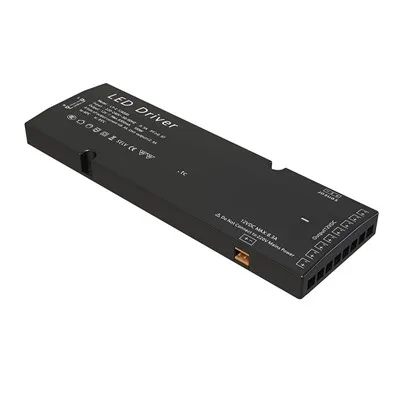

Since the light characteristics of LEDs are typically described as a function of current, not voltage, the relationship between luminous flux (φV) and luminous flux inflection (IF) is crucial. Therefore, constant current source driving allows for better brightness control. Furthermore, the forward voltage drop of LEDs varies considerably (up to 1V or more). As shown in the VF-IF curve above, even a small change in VF can cause a significant change in IF, resulting in a substantial change in brightness. Therefore, constant voltage source driving cannot guarantee consistent LED brightness and negatively impacts LED reliability, lifespan, and light decay. Consequently, ultra-high brightness LEDs typically employ constant current source driving.
The temperature-luminous flux (φV) relationship curve for LEDs shows that luminous flux is inversely proportional to temperature. The luminous flux at 85℃ is half that at 25℃, while at -40℃ it is 1.8 times that at 25℃. Temperature variations also affect the wavelength of LEDs; therefore, good heat dissipation is essential for maintaining constant LED brightness.